20 Smart Ways To Enhance Your Front Door Curb Appeal With Flowers

It is time to clean up your front porch and think about your summer look. Here are 20 ways to spruce up your curb appeal.

What’s the first thing people see when they approach your home? Your front door! Since it is highly visible (even from the street), choosing how to style and decorate your front door area could take some planning.

If you want to leave your guests with a good first impression, read on! We’ve come up with several ways you can personalize and decorate your front porch area.

From antique lighting, over-sized planters to welcoming seating areas, we show you a variety of ideas.

One of our favorites is #12, a do-it-yourself flower tower that looks so adorable. Also be sure to check out #20, a unique woven flower bed that’s sure to catch some attention. Go ahead and start browsing the ideas below, you’ll be glad you did when you walk away with some great ideas and inspiration.

1. Antique Light Fixture:


2. Beautiful Barrel Planters on Wheels:


3. Bold and Bright Flower Arrangement:


 4. Bright Topiary:


 5. Oversized Matching Planters


6. Shrubs in Terra Cotta Pots:


7. Stylishly Manicured Shrubs:
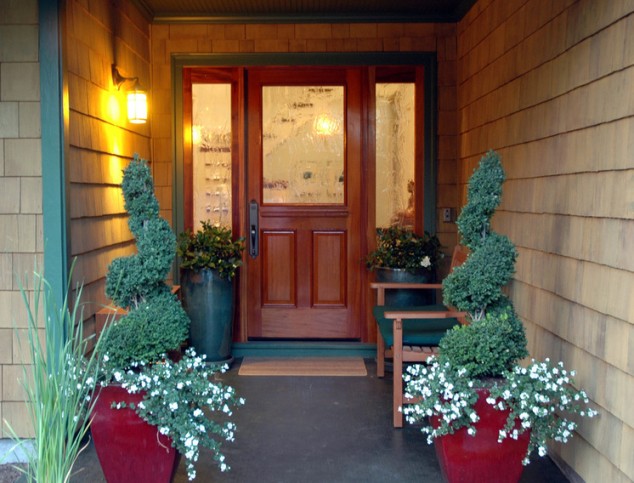


8. Tall and Elegant Planters


 9. Warm Lighting and Flower Arrangements:


10. Welcome Home Arrangement: 


11. Bird Bath and Flower Bed:


12: DIY Flower Tower:


13. Flowers in a Charming Chair:


14. Colourful Headboard Flower Planter:


15. Log Flower Bed:


16: Raised Brick Flower Bed:


17: Raised Flower Beds with Lighting:


18: Vertical Flower Bed:


19. Window Flower Bed:


20: Woven Flower Bed:


Pure Maple Syrup Has Some Oh-So-Canadian Health Benefits

Spring is here and that means that the maple trees will start to run.  This natural product tastes delicious, is a great alternative to sugar and it has great health benefits.


Oh, Canada! Our beloved home, and also the home of the liquid gold known the world over as pure maple syrup.

Maple syrup is as Canadian as hockey, snow, and our classic red and white. But did you know that this liquid gold also has genuine nutrition benefits?

Yes, it's almost a dream come true -- the pure maple syrup that we so love DOES have nutritional value!

But let's go back to the roots (pun intended) of how maple syrup was discovered. My dad was a maple syrup harvester for a short time and LOVES telling me the history of pure maple syrup. Early European settlers in the U.S. Northeast and Canada learned about sugar maples from indigenous peoples.

Various legends explain the initial discovery. One is that a tribal chief threw a tomahawk at a tree, sap ran out and his wife boiled venison in the liquid. Another version holds that Native Americans stumbled on sap running from a broken maple branch.

It takes about 40 gallons of sap to make one gallon of maple syrup because sap is about 98 per cent water. The sugar water is boiled over a wood fire -- and what's left is the brown, sweet syrup with which we're familiar. Some sugar makers heated the sap further, creating crystallized sugar.

So, what is it about maple syrup that has health benefits?


1. It contains antioxidants.

Antioxidants help to fight the damage that toxins and unhealthy habits and foods cause to our bodies, which eventually result in sickness and disease. In a study done comparing the antioxidant capacity of natural sweeteners, pure maple syrup has shown intermediate antioxidant capacity, along with black strap molasses (which actually have the highest antioxidant capacity. White sugar (refined), corn syrup AND agave syrup all showed MINIMAL antioxidant activity.

In fact, pure maple syrup has 24 known antioxidants. When available, choose Grade B maple syrup -- which is darker -- as it has a higher antioxidant capacity.

2. It contains manganese

Pure maple syrup offers a sweet dose of the important mineral, manganese.

Manganese is often overlooked, but it is a vital mineral in our enzymatic systems for carrying out energy production, bone formation, and protein metabolism. Soil mineral loss related to high tech farming has created a depletion of the mineral manganese, making it more necessary to consciously seek ways to increase our intake of this mineral.


Source

Calgary's suburbs are 'no place to grow old,' says researcher

Photo credit: Grant Black Calgary Herald

ANNALISE KLINGBEIL, CALGARY HERALD
Published on: March 13, 2017


It was a conversation a decade ago with a friend who worked as an old age psychiatrist that spurred Glenn Miller to research how Canadian suburbs can become age-friendly.

“He said, ‘You planners, you’ve got to do something about a problem I deal with every day,'” Miller said.

The problem Miller’s friend faced again and again was advising patients they shouldn’t be driving anymore.

The doctor had countless stories about adult children doing whatever it took to prevent their parents from getting behind the wheel, from hiding car keys to removing parts of a vehicle so it wouldn’t start.

For many people, being told it’s time to stop driving can end life as they know it.

“The biggest problem is the risk of isolation,” said Miller, a senior associate with the Canadian Urban Institute in Toronto. “Driving is your way to engage with people in the community. You lose the ability to freely go about your daily routine.”

Inspired by the long-ago conversation with his friend, Miller recently authored a 26-page report examining aging and city planning, released last week by the Institute for Research on Public Policy, a national think tank.

The report concludes municipalities across the country must rethink development policies to deal with the impact of car-dependent suburbs that leave seniors with limited mobility isolated — a topic that’s especially pertinent to Calgary, a traditional poster child for suburban sprawl.

“It is fair to say that our current suburbs are no place to grow old,” Miller states in the report.

The report states 66 per cent of the Canadian population lives in some form of suburb, a fact that’s troubling when combined with the knowledge one out of every four Canadians will be over the age of 65 in fewer than 25 years, including nearly 1.5 million Canadians who will be over the age of 85.

“We’ve created all these places that were great for the family formation years, when people were raising their kids and driving around here, driving around there,” Miller said.

But, as Canadians age, “they’re in places where they can no longer get to anything easily if they don’t have a car.”

Source Article